The clock is ticking-why we need to respect plants


Remember we have only been farming and gardening for a few ten thousand years,  nature including  plants have been around billions of years.

Up to a hundred years or so ago we mostly grew our food without the use of artificial pesticides,  fertilizers, and fossil fuelled heavy machinery. Leaving our pristine rain forests to their native populations to manage.

But since the human population explosion just over the last  60 years from 2.5 billion to a frightening 7.5 billion!  Deforestation has followed mostly to provide land for Farming and Agriculture. An estimated 18 million acres of rain forest is lost each year and at this rate there will be no rain forests left in less than 100 years. But long before this doomsday scenario, the  effects of overpopulation, such as water poverty and famine, increasing conflicts and loss of biodiversity will be irreversible.

Other reasons the forests are decimated are, logging, mining, urbanization and lately planting of biofuels. This is a significant contributing factor for increasing CO2 emissions around 15%- 20% of the worlds Oxygen is produced in the Amazon forest alone. When you think that around 280 billion tons of carbon are stored in the worlds forests, to continue destroying them seems like total madness.

We are all personally responsible to reduce our consumption of  tropical unsustainable timbers, in the form of paper, garden furniture, decking,hardwood flooring, window frames and other household furnishings such as veneers, fancy boxes or marquetry-55021antique-sideboard-948527Mahogany sideboards. Rain forest timber is usually cheaper than native hardwood timber mostly because it hasn’t been planted by man so the only cost is logging. 

We as a human race need to learn how to live in harmony with plants and treat them with the respect they deserve. We are already witnessing the beginning of another mass extinction of species which is the Earths natural purging mechanism when things get out of balance.

Events such as, rising sea levels,increasing strength of hurricanes and cyclones, floods, landslides, vast wild fires,wildfire-1105209 mass dying of  coral reefs, emergence of pandemics of virulent, relatively rare diseases like Zika, AIDS and Ebola viruses. These all threaten ours and our animal partners survival. We will all be long  gone before plants die out!life-863034

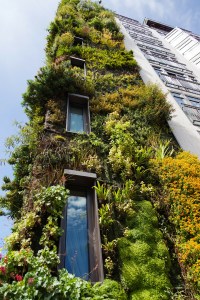
we can all make a difference by growing and planting  eco-friendly  plants, like bamboo and trees on every available space , on walls, roofs and terraces, and tops of lower mountains. We need to eat less meat especially beef  and return grazing land to forests.architecture-21702_1920
Currently a staggering 30% of all agricultural land is used for meat production and is one of the main reasons for the 140% increase in CO2 emissions in Asia alone since 1965. And it’s estimated that nearly 25% of all emissions released, are a consequence of meat production. 

Bamboo an alternative eco-friendly agricultural resource?CIMG7188

1. Bamboo absorbs CO2. In fact it releases 33% more Oxygen than the equivalent hardwood forest.

2. Bamboo is very fast growing, up to 2-3 feet/day, you can actually hear it as it extends upward! It can be harvested in 2-5 years, rather than 50-100yrs for hardwoods. It then regrows from its lateral shallow roots, without any maintenance.

3. It is a great resource for beautiful furniture or flooring, and is far less susceptible to moisture and decay. It is a great garden soil enrichner and mulch I use it all the time, just shred it and add it to the compost bin or just rake it in at the end of the season ready for next spring. None of the plant is wasted.

panda-655491

Yummy

4. Bamboo unlike other crops does not need fertilizers or pesticides, it takes care of itself, by fixing nitrogen into the soil. Bamboo fibres are much more resilient than wood fibres and more waterproof.park-1456270_1920

5. After bamboo is harvested its roots remain in the soil to feed the next crop and will bind the soil and nutrients preventing soil erosion and rapid run off that leads to flooding down stream. It is extremely resilient to varying weather conditions such as high winds, drought,flooding,tidal surges and very low temperatures.

so get out there and plant bamboo in places where little else grows or is susceptible to erosion, up river of flood hit areas and exposed coasts and hillsides, it’s easily contained with barriers a couple of feet deep and few inches high it could be used as hedging or fencing or even a bamboo maze, now there’s an idea! Largest bamboo maze ever!

Gingko Biloba Tree-A Living Fossil!

Gingko Biloba first appeared over 270 Million years ago during the Permiam period so was well established during the dinosaurs Jurassic period, 60 million years later. This beautiful and early example of tree life on earth is truly an astonishing survivor of evolution. This maybe partly due to it’s longevity, there are living examples over 2500 years old in China today.

It wouldn’t surprise me if we find them growing on other planets in the universe, with algal mats 2.3 Billion years old, club mosses and liverworts 450 million years old and ferns 360 million years old. If there are Aliens out there they are most likely to be these!

There was remarkably a Gingko here in our Woodland till about 11 years ago, when it sadly died, we still have a cross section of the trunk and it was over 100 years old.

Gingko evolved during a time when there was only ferns, mosses, algae and Cycads around, long before pine cones or flowers came along for cross fertilization.

cycads-1541391_1920

Sago palm a Cycad


fern-123538_1920

Tree fern

The male sporophylls in the pollen cones travel on the wind to the large fruit like seed fallen from the female tree, which has a tiny opening that captures the pollen, it then produces the motile spermatozoid which swim toward the female cell inside and fertilize it. Truly remarkable and prehistoric!

The Gingko can grow up to 50m in height, and likes a sunny position in a rich moisture retentive but well drained soil. Our young Gingko is growing happily in the woodland glade. It is easily grown from seed or branches with aerial roots. It is free of pests and diseases, they probably all died out millions of years ago! The beautiful maidenhair like leaves turn a bright yellow in Autumn and light up the wood.

The health benefits are spurious, apart from some studies showing improvement in memory and concentration in older people, maybe secondary to its circulation and blood thinning properties, and should be avoided in people with bleeding tendencies or taking Aspirin. For similar reasons, also not mixed with ginger, ginseng or garlic. Some people are allergic to gingko and can get skin rashes from the seed outer skin and leaves of the plant.

The shelled ‘nuts’ are highly prized and used in many recipes in china eg.  Buddha’s delight. A delicious vegetarian stir fry dish served on special holidays such as the Lunar New Year, tofu, shitake mushroom, gingko nut, lotus root, wood ear mushroom, water chestnut, black moss, braised gluten and thread noodles are some of the chief ingredients.

Honeysuckle-Lonicera caprifolium

A climbing shrub up to 20 feet, distributed  widely in central and southern Europe, it is also naturalized in hedgerows and woodland in the UK as an escapee from gardens.  Many species grow in China.

CIMG7084

Lonicera japonica

It has highly fragrant flowers, especially in the evening and is commonly grown on a trellis or pergola and is pollinated by moths, bees and butterflies, birds love the berries. It prefers humus rich soil with regular feeding, mulch with well rotted manure or blood fish and bone fertilizer, for best results. Water with a non hard water or rain water. Grows in sun or partial shade and is fully hardy. Prune back long growth in spring and make sure its not overcrowded as this makes it susceptible to mildew.

Thought to be useful in treatment of colitis and for coughs and colds with fever, the flowers are infused to make a calming yet uplifting tea.  Or for pot pourris. Some honeysuckles are poisonous and even in our common species the berries leaves and vines should not be taken as they contain high levels of saponins.

The vines have been used to make strong rope for bridals and harnesses as far back as the Bronze Age, and is extremely tough when dried. It has long been associated with love and fidelity, and those who wear honeysuckle  were said, will dream of their true love. Why not grow a honeysuckle up a hardwood sapling like ash or tropical cherry to produce a spiral walking stick.Vinewrapped004

Myrtyl-Myrtus communis

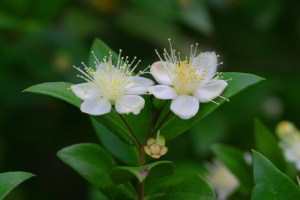
Myrtyl is a beautiful evergreen shrub, with leathery oviate leaves and small starry white flowers with yellow stamens.flower-1291003_1920

It grows up to 10 feet on the coastline of the Mediterranean and was brought to the UK by Sir Walter Raleigh in the 16th Century from Spain.

It likes a moist but well drained neutral to sl. acid soil and needs protection from frosts and harsh winds, in a sheltered sunny position. The flowers appear after a long hot summer. Water with collected rain water or calcium free water. It can be trained as a bonsai. And is commonly used as hedging and topiary in warmer climates.

The leaves  and blue black berries are very aromatic due to the Myrtol Essential oil in them and are used to flavour meats especially sausages, and a popular drink from Sardenia called Mirto is made from macerating the leaves in alcohol.

In Greek mythology it is the sacred herb of Aphrodite and considered a symbol of love and immortality, hence  being worn as a bridal garland and used in wedding ceremonies. The scented leaves can be added to pot pourris or for bathing.

Yerba Mate

Yerba Mate-Ilex Paraguariensis is an evergreen tree, and member of the Ilex holly family which grows widely on the hillsides of Latin America up to 50 feet or 16m in Ht.220px-Yerba_Mate  When processed it makes the tea beverage Mate. The branches are cut up and dried over an open fire, imparting a smoky flavour, it is threshed to remove twigs then aged which improves the flavour.
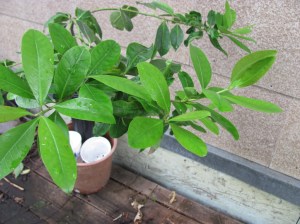
It contains about 1% caffeine by wt. And is socially drunk from a gourd through a metal straw passed around a group. Nowadays the vessel maybe made of ceramic, plastic or silicon even.

Apart from the caffeine and some theobromine, it contains the polyphenols flavanoids , quercetin and rutin. It has stimulating and fat burning effects and may help in lowering blood sugar. It also reduces the sense of hunger.

ilexp (2)You can grow  Yerba Mate from seed and make your own tea, the seeds need a few weeks stratification period ie regular dips in temperature for proper germination.  Scratching some of the hard seed coat is recommended, soak in water overnight then into a 50/50 perlite/loam mix. Germination is slow keep out of direct sunlight and frost until well established 2-3 foot. A bit like Camellia sinensis (regular tea).